
Writing / Measurement & applied AI
What you can actually measure about your visibility in AI search
Google's AI search reports and its analytics channels draw different boundaries around the same subject.

Search Console's dedicated Generative AI performance report covers impressions in AI Overviews and AI Mode. In GA4's default channel grouping, traffic from those experiences belongs to Organic Search alongside other organic search traffic. The channel called AI Assistant explicitly excludes them. [1][2]
That has a practical consequence: taking AI Assistant sessions from GA4 and dividing them by Google AI impressions will not give you an AI click-through rate. The visits and impressions cover different sources. Sessions are also different from clicks, so changing the channel alone would not fix that calculation. [3]
Before judging AI performance, define what the measurement includes. A dashboard can put related numbers beside each other without making them parts of the same customer journey.
Follow the definition, not the label
“AI visibility” can mean that your business was mentioned in an answer, that a page was cited as a source, or that a platform recorded an impression. Website visits answer a further question: did someone arrive?
Start with the decision you need to make. If you want to know whether a particular page is appearing in Google AI search, inspect the relevant impressions report. If you want to understand visits from recognised AI assistants, inspect the analytics channel and its sources. To judge how an answer describes your business, read the answer.
Google's documented reporting makes the distinction concrete:
Scroll sideways to read all three columns.
| Source | What it covers | How to use it |
|---|---|---|
| Search Console Generative AI performance report | Impressions in AI Overviews and AI Mode | Examine appearances within those Google experiences. |
| GA4 Organic Search | Includes traffic from AI Overviews and AI Mode alongside other organic search traffic | Keep the broader channel definition visible; the total is not an AI-only traffic measure. |
| GA4 AI Assistant | Recognised AI-assistant traffic, excluding AI Overviews and AI Mode | Analyse recorded assistant visits within this channel's coverage. |
These are the documented categories, not interchangeable definitions of AI search. [1][2]
Changing the chart title to “AI traffic” would hide the exclusion. A clearer title preserves the actual channel name, with a note explaining where Google's AI search traffic is classified.
What an appearance report lets you say
Google's dedicated report documents impressions with breakdowns including pages, countries, dates and devices. It does not document clicks or click-through rate in that report. Check whether data is available for your property: absence of the report is not sufficient evidence that your content has never appeared. [1]
Bing measures appearances differently. Its AI Performance public preview reports citations across Microsoft Copilot, Bing AI summaries and selected partner integrations. A citation records a source reference; it does not establish that someone visited the page. Preserve the stated platform coverage when reporting the result. [4]
Bing's preview Citation Share also needs its definition attached. It reports your site's citations as a percentage of all citations across sites for the same grounding query, a grouped phrase describing retrieval context. It is not a share of website visits or an overall measure of market share. [5]
Connect visits to outcomes within the same scope
Recorded visits are useful evidence in their own right. OpenAI documents adding utm_source=chatgpt.com to referral URLs from ChatGPT search results to help publishers identify incoming traffic. That tag describes arrivals, not every answer in which a publisher appeared. [6]
For a session-based GA4 report, use Session default channel group and keep the session scope consistent when examining channels and sources. Google's documentation distinguishes session-scoped channel attribution from event-scoped attribution. Mixing those views can change the question your report answers. [2]
Then examine what those recorded visits did. A completed enquiry form is more useful to a lead-generation business than an undifferentiated visit count, provided the tracking actually records completed enquiries. A contact-button click shows intent; calling it an enquiry would overstate the action.
Keep that outcome attached to the visits being analysed. It can support a statement about recorded behaviour. It cannot, on its own, show that AI caused additional business that would otherwise have been lost.
Some visits will lack clear source information. GA4's Direct category can include traffic without clear referral information. Its presence does not tell you how much undisclosed AI traffic you have, so do not use Direct to fill a gap in the AI report. [7]
Visual reference
Keep these three questions separate when you report on AI search.
Open full-size infographic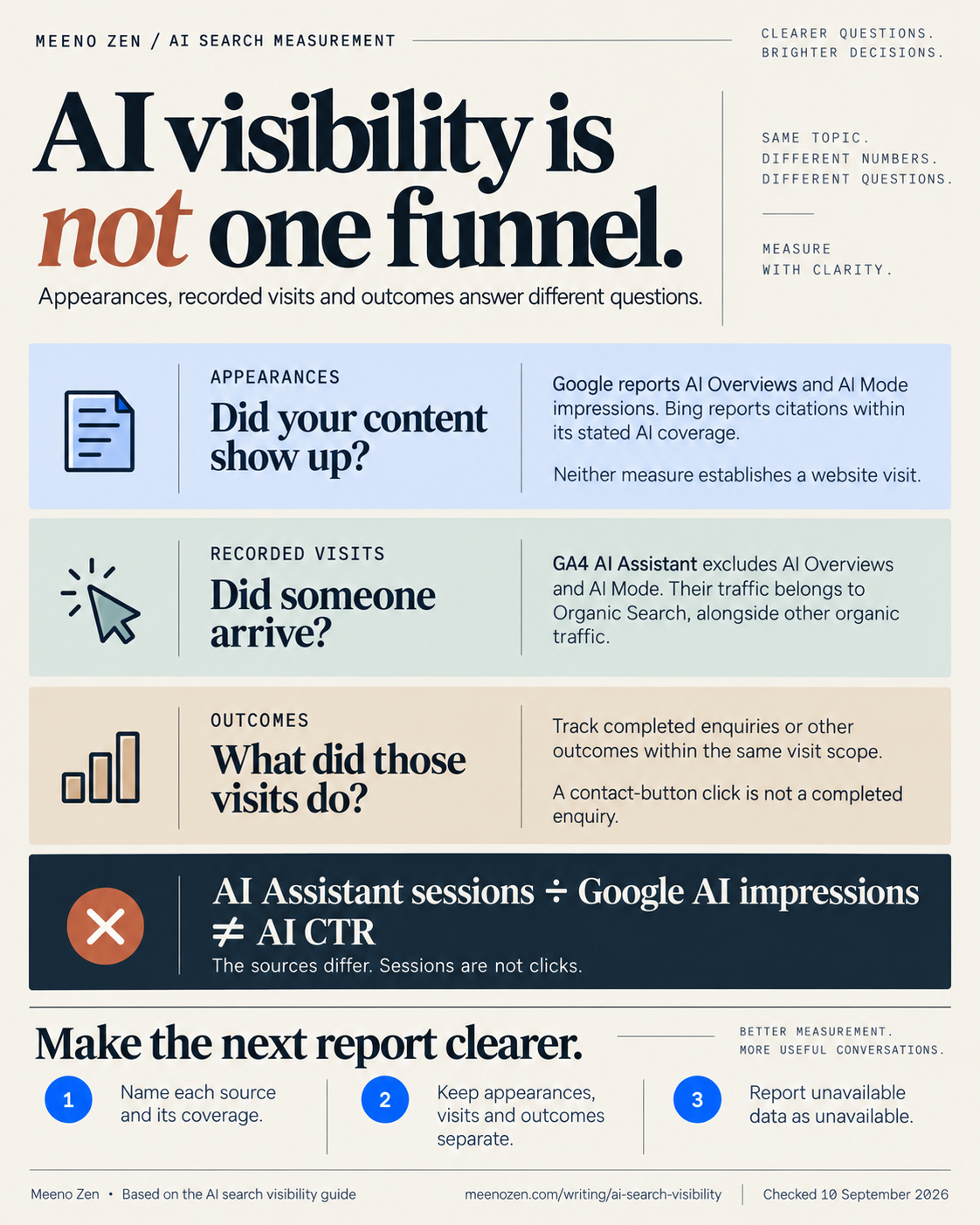
Read the infographic as text
AI visibility is not one funnel. Appearances, recorded visits and outcomes answer different questions.
- AppearancesDid your content show up?
- Google reports AI Overviews and AI Mode impressions. Bing reports citations within its stated AI coverage. Neither measure establishes a website visit.
- Recorded visitsDid someone arrive?
- GA4 AI Assistant excludes AI Overviews and AI Mode. Their traffic belongs to Organic Search, alongside other organic traffic.
- OutcomesWhat did those visits do?
- Track completed enquiries or other outcomes within the same visit scope. A contact-button click is not a completed enquiry.
AI Assistant sessions ÷ Google AI impressions ≠ AI CTR. The sources differ. Sessions are not clicks.
To make the next report clearer, name each source and its coverage, keep appearances, visits and outcomes separate, and report unavailable data as unavailable.
Meeno Zen. Based on this article. Checked 10 September 2026.
Ask suppliers to explain the score
Once you know what you need to measure and which business outcome matters, you can judge whether a supplier's report helps. Similar-looking percentages may use different platforms, questions and denominators. Ask what total is used to calculate the percentage before deciding that one score is better than another.
A prompt-monitoring tool can help inspect questions that matter to your business. Its usefulness depends partly on what it chooses to ask.
For a score calculated from tracked prompts, changing that prompt set changes the measurement sample. The score can move even without a content edit. Keep the prompt set fixed or explain the change alongside the comparison. [8]
Request the prompt list, platform, language, settings and collection schedule. Check whether the questions cover the products, services and decisions relevant to your audience. If a result is based on a set of checked answers, describe that set in the report. Do not present it as the proportion of all platform users who encountered your business.
For comparisons over time, keep the method stable or explain the change. A new prompt set can alter which businesses appear. Changes in demand, models and the web can also affect results; Microsoft explicitly identifies these limits in its comparison guidance. A rise after a content edit is a reason to investigate, not proof that the edit caused it. [5]
Make the next report easier to interpret
Keep appearances, recorded visits and outcomes in separate sections. Beside each measure, name the source and the coverage that matters to the reader. Report unavailable data as unavailable.
For the Google mapping above, that means preserving “AI Overviews and AI Mode impressions” for Search Console, “AI Assistant sessions” for the GA4 channel, and the exclusion linking them. Neither belongs in a calculation that assumes they measure successive steps in the same journey.
The useful question for the reporting meeting is then specific: what changed within this defined measure, and what should we investigate or do because of it?
Takeaways to keepTwo image downloads
Sources8 references
Evidence & further reading
Numbered references in the article point to the documents below. Each title opens the original source.
- 01
Google Search Console
Generative AI performance report - 02
Google Analytics
Default channel group definitions - 03
Google Search Central
Comparing Google Analytics and Search Console metrics - 04
Microsoft Bing
Introducing AI Performance in Bing Webmaster Tools - 05
- 06
- 07
Google Analytics
Understanding Direct traffic - 08

How I connect stakeholder questions, measurement design and agency delivery so reporting leads to a useful next step.
Explore the measurement case